

Obi-Wan Kenobi’s Lightsaber
From Prop to Toy
Rebecca Harrison with Siti Syuhaida Mohamed Yunus
Additional research by Mark Williams
The team that created the original lightsabers for A New Hope back in 1976 relied on scrap items that would otherwise have been discarded. Today, meanwhile, there are thousands of replica ‘laser swords’ available to buy in shops. We review the lifecycles of two lightsabers to think about the value of reused materials, and how props proliferate beyond the screen.
Summary
The lightsaber is one of Star Wars’ most famous assets. But while the prop saber used by Obi-Wan Kenobi in 1977’s A New Hope was crafted from parts found in junk shops – thus producing little to no carbon dioxide emissions – the environmental impact of the approx. 10 million toy lightsabers manufactured and sold each year is far, far greater.
We have discovered that a single toy – dating from 2022 and retailing for around £26 – is responsible for emissions equivalent to around 2.13 kg of carbon dioxide. If we multiply this figure by 10 million, the total annual emissions for lightsaber toys would be 213 kilotons. ‘Offsetting’ such emissions in a year would require 101 million healthy, full-grown trees.
Our research into the respective provenances of prop and toy lightsaber offer some lessons for the film industry.
First, art department teams can follow the approach adopted on A New Hope: salvage used, waste, or recycled items and creatively refashion them.
Second, the most obvious solution is to stop mass producing and consuming toys altogether, which would require film studios to refuse to license their IP to manufacturers. Of course, fans could continue to craft their own replicas.
Failing this, studios and the agents who manage licensing on their behalf should pay close attention to the environmental credentials of any potential licensee and write stringent conditions into their licensing agreements: only recycled materials, no single-use plastics, renewable energy sources, limited product numbers, etc.
Manufacturers could also make changes, for example, by switching to recycled aluminium, encouraging the recycling of rechargeable batteries, and running factories on renewable energy.
Third, consumers and fans have an important role to play. We can all demand that corporations do better and champion a fan culture in which the homemade and/or locally-produced are valued more highly than their mass-produced counterparts.
Read on for the full case study.
Introduction
Lightsabers are known to millions of people around the world as the weapons of the Jedis and their Sith opponents in Star Wars. From the 1978 inflatable model released by toy-manufacturer Kenner (which came with a free puncture-repair kit), to bespoke, hand-crafted replicas made by independent ‘sabersmiths,’ people of all ages have bought into the lightsaber trend.[i]
Toys have been crucial to the saga’s success from the outset. George Lucas’s decision to license Lucasfilm’s intellectual property (IP) to Kenner in 1977 gave him the financial freedom to make further Star Wars films outside of studio control.[ii] Lucas’s canny rights deals with soft drink, fast food, clothing, and other retailers is widely acknowledged as establishing a business model that Hollywood studios have been emulating ever since.
Within Star Wars fandom, collecting toys and memorabilia is often crucial to people’s sense of belonging.[iii] And the ‘laser sword’, as the lightsaber has been known, is so popular among fans that in 2014 (in a gap between Star Wars trilogies, and before the sequel movies revitalised interest in the franchise), Disney, as recent buyers of Star Wars IP from George Lucas, was selling 10 million lightsabers per year.[iv]
Consequently, in this case study, we set out to examine the environmental impacts not only of an onscreen prop – in this case, Obi-Wan Kenobi’s lightsaber from the very first Star Wars film, 1977’s A New Hope – but also, the global warming potential of a replica toy. What materials are the two lightsabers made from? How do their carbon footprints compare? And what can studios do to lessen the environmental harm that their IP sales lead to off screen?
To answer these questions, I’ve explored advertising, press, and the material histories of lightsaber components. Mark Williams drew on fan sites and conversations with sabersmiths. Together, Dr Siti Syuhaida Mohamed Yunus and I dismantled and assessed a toy lightsaber. Dr Mohamed Yunus then calculated likely carbon emissions based on these findings. We’ve also created a tool to help you calculate the likely footprint of your own IP: at the bottom of the page, you can select different materials and shipping options to see how your assets stack up.
Obi-Wan Kenobi’s Saber
The lightsaber used by Obi-Wan Kenobi in the 1977 film (each character has their own unique saber hilt) was made from found parts. Designer Roger Christian prided himself on being able to source scrap materials and turn them into believable, weather-worn assets fit for a galaxy far, far away. In an interview for the EIF project, he described buying ‘parts of airliners and many Rolls Royce jet engines, telephone exchange interiors that were being torn down, and skip loads of broken discarded camera parts, calculators, cash machines – anything and everything.’[v]
Thus, Obi-Wan’s lightsaber [Figure 1] comprises the clasp from a Graflex camera flash (a portable camera popular with journalists in the 30s and 40) that Christian sourced in a shop just off Tottenham Court Road. This was augmented by a bubble strip that came from a calculator sold when a telephone exchange in West Hampstead closed down.[vi] There’s a part from a defunct Rolls Royce Engine, First and Second World War weapons in the form of a rifle grenade and machine-gun muzzle, and early computer electronics. A plastic rod and Scotchlite retroflector sheet made up the blade (the glow came from rotoscoped animation). It’s a product, then, of the military-industrial complex, and one that speaks to technological change across a range of industries that were discarding unwanted, out-of-date parts.
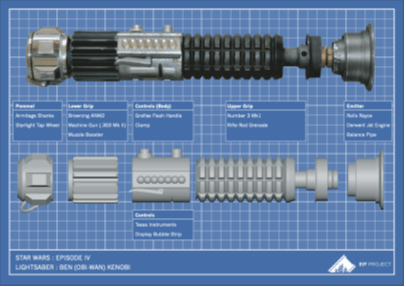
That is, aside from one component that will be familiar to many readers owing to its ubiquity in public bathrooms: the Armitage Shanks Starlite tap wheel [Figure 2].
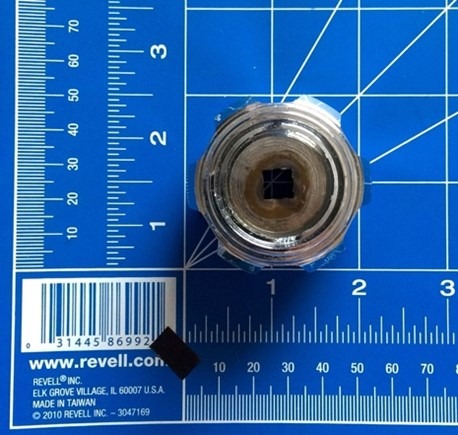
Whether domestic or militaristic, though, the ‘found’ provenance of the lightsaber is testament to the ingenuity of creative talent to transform junk, scrap, and rubbish into an iconic prop. By repurposing existing items that would otherwise have been destined for landfill, Obi-Wan’s laser sword was about as environmentally friendly as they come at the point of making.
The Toy Saber
Turning franchise IP into merchandise has been very lucrative for Star Wars rights holders. In 1999, the Wall Street Journal estimated that annual sales of Star Wars toys were typically around $20 million; toys released in conjunction with The Phantom Menace (released in 1999) were expected to make between $800 million and $1.3 billion in sales.[vii]
Lightsabers in particular have been popular with fans and collectors. In 2005, Luke Skywalker’s lightsaber from A New Hope sold for £113,000 at an auction of movie props and costumes in California.[viii] Even the Star Wars cast seem taken with them. On set for the prequel shoots, Ewan McGregor had to be reminded not to add his own sound effects (‘wrrmm’) when using the prop; Hayden Christensen wanted to take his home. Samuel L Jackson lobbied for his own unique purple blade, and according to stunt coordinator Nick Gillard, ‘“kept his lightsaber with him 24 hours a day – he had it in his golf bag.”’[ix]
For our case study, we’ve used a low-to-mid-range Lischwert lightsaber that retails for around £26 [Figure 3].[x] It has seven light-up colour options, three voice modes, and produces sound effects that replicate those from the films. Made in China, its rechargeable battery suggests it was manufactured in 2022.
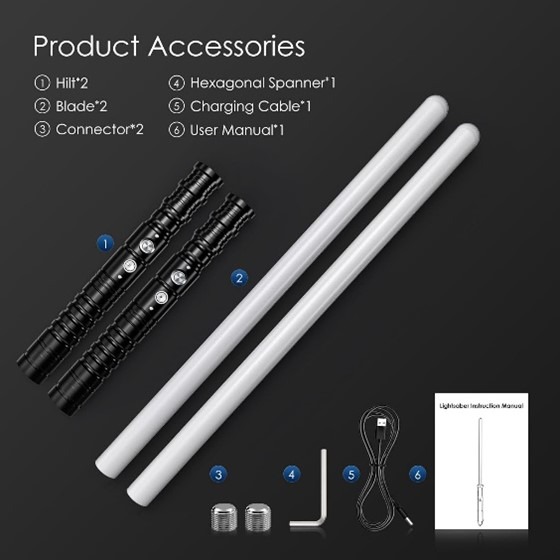
On dismantling the toy, we found it contained a range of materials. The metal handle was aluminum and provided casing for an electronic circuit board and wires, the battery, a lens (for lighting up the plastic blade), and a small amplifier for the sound effects. All the parts were held in place with glue or screws. Our model was originally bought for a promotional event and so we were able to dismantle a ‘pre-loved’ saber.
Life Cycle Assessments
To determine the likely global warming potential of the prop and toy, we’ve carried out life cycle assessments (LCAs) using Ecoinvent data. When calculating the amount of materials used in the prop lightsaber, we referred where possible to the measurements of components, and the weights of original parts.[xi] Where no data were available, Dr Mohamed Yunus estimated the weight of materials based on the dimensions from a scale drawing, and then made dimension-to-weight conversions. Owing to the complexity of calculating energy use and emissions in the manufacture of each found part, and the fact that the film production was recycling scrap, our lifecycle assessment accounts only for the raw materials used. The unit of measurement used is CO2e, which translates all likely emissions into an equivalent amount of carbon dioxide.
For the toy, our study includes raw materials (plastics, aluminium, glues, etc.), shipping from a factory in China to a distribution centre in the UK, and 2000 battery re-charges (typical for the model in the toy). We did not include manufacturing processes to make a fairer comparison. You can download the data for both assets below.
Download lightsaber prop data
Download lightsaber toy data
Results
According to Dr Mohamed Yunus’s calculations, the prop produced emissions of around 4.1 kg CO2e. Most of its carbon footprint resulted from just two parts: the aluminium Graflex clamp (1.6 kg CO2e) and the Marconi transistor (1.9 kg CO2e). The latter, as a ‘greeblie’ (i.e., not functional or structurally integral part of the prop, but rather added for aesthetic effect), could arguably have been left off to reduce the prop’s global warming potential. However, as a found and repurposed part, it was preventing waste from going to landfill and so its reuse would not have generated further environmental harm.
At first glance, the total global warming potential for the toy is lower than that of the prop at 2.13 kg CO2e. The highest contributor to emissions is the casing, accounting for roughly 35% of the total. While raw materials account for 29% of the toy’s carbon footprint, the energy consumption at the user end for recharging the battery (assuming it’s recharged the maximum number of times) contribute a huge 69% of the likely emissions through electrical energy use.
However, first impressions can be deceptive. When we account for the lightsaber prop’s repurposing of materials, the kinds of materials used to make both assets, and other emissions such as nitrous oxide, a different picture emerges of likely environmental harm [Figure 4].
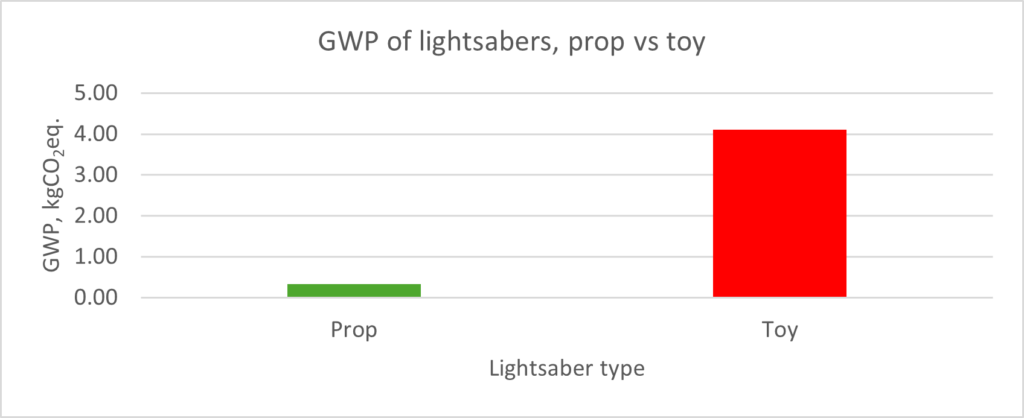
As Figure 4 shows, comparatively the toy has a much greater environmental impact than the prop. This is because the lightsaber prop used repurposed parts rather than new raw materials, and did not contain any electrical components. It did not require energy to maintain it at the user end, either. Moreover, it’s likely to be kept and archived and so would avoid ending up in landfill – the likely destination of the toy.
It’s also important to note that we’ve produced data for just one toy. Taking our model as a very rough average (many will be smaller, larger, simpler, more complex, or made of different materials), if 10 million of them were sold in one year (as per the 2014 Time report), their carbon footprint would be an enormous 213 kilotons CO2e.[xii] It would take more than 101 million healthy full-grown trees to offset a year’s worth of emissions in an equivalent timeframe by absorbing the polluting gases.[xiii]
You can test material and shipping options for your own IP (real or imagined) using our calculator.
What Can We Do?
In a positive example of good practice, art department teams can learn from Roger Christian and coworkers’ approach to prop design on A New Hope. Salvaging used, waste, or recycled items and creatively refashioning them reduces the need for additional materials or manufacturing processes, and saves them from landfill.
There is a greater challenge when it comes to licensing IP to toy manufacturers, though.
The most obvious solution to the problem of mass production and consumption of Star Wars lightsaber toys is to stop making them altogether. Corporations like Disney must be held accountable for putting profits before environmental sustainability. Climate change is making the world unliveable for people in California, where Lucasfilm is headquartered and where George Lucas had Skywalker Ranch built, not to mention Pakistan, Mexico, Malawi and beyond, owing to floods, droughts, and crop failures. Does anyone really need another toy lightsaber?
Of course, in all likelihood, people working in corporate interests would say ‘yes.’ As Michael Kwet points out, intellectual property rights ‘date back centuries.’[xiv] However, they ‘became a fixation of the West in the late twentieth century as western corporations came to dominate’ – and to benefit financially. So what can anyone do to mitigate the environmental harm done by toy licensing?
For a start, studios, or agents managing IP licensing on their behalf, should check the environmental credentials of any potential licensee (in addition, one hopes, to gaining assurances about working conditions and pay for staff). Additionally, it’s feasible that rights holders could borrow from the ‘green riders’ that some actors demand to ensure that productions commit to eco-friendly initiatives.[xv] Studios could attach conditions – only recycled materials, no single-used plastic, renewable energy sources, limited product numbers – into their licensing agreements.
Manufacturers, too, could make changes. For example, in making lightsabers, they could switch to recycled aluminium, and encourage recycling of rechargeable batteries (which, while more energy efficient than single-use, contain toxic chemicals that require specialist disposal).[xvi] They could also ensure their factories run on solar, wind, or wave energy. More emphasis on local production would diminish the emissions generated by global distribution, too.
Corporate responsibility and change, then, is crucial to any reduction in environmental harm caused by the IP-retail pipeline. That doesn’t mean that we don’t have a role to play as fans or consumers, though. It’s in all of our interests to prevent worsening climate change. Rethinking our need to collect plastic items, reimagining how we perform fandom, and being mindful of how we buy or bin merchandise is imperative. Where we do make purchases, pre-loved or second-hand are eco-friendlier options.
Recognising that as workers, fans, and consumers – as people – we have collective power to pressure corporations to do better, we can demand the change we’d like to see. Maarva Andor would surely approve.[xvi]
If you use this case study or related calculator in your work, or have any questions about the project, please do take a minute to let us know by completing a short survey. Your feedback will help us develop further resources and apply for additional funding.
Notes
[i] John Waterhouse, “Playing Jedi: The History of Toy Lightsabers,” StarWars.com, May 24, 2016, https://www.starwars.com/news/playing-jedi-the-history-of-toy-lightsabers; Interview with Daren Speakman of JQ Sabers, October 18, 2023.
[ii] For more information on the impact of the sales strategy, see Rebecca Harrison, BFI Film Classics: The Empire Strikes Back (London: Bloomsbury), 10.
[iii] For further analysis of Star Wars toys and their importance to fans, see Suzanne Scott, ‘#Wheresrey?: Toys, Spoilers, and the Gender Politics of Franchise Paratexts,’ Critical Studies in Media Communication 34, no. 2 (2017): 137-148.
[iv] Victor Luckerson, “You’ll Never Believe How Many Lightsabers Disney Sells Every Year,” Time, June 17, 2014, https://time.com/2891108/lightsaber-sales/.
[v] Interview with Roger Christian, online, July 14, 2023.
[vi] Ibid.
[vii] Joseph Pereira, “Values Won’t Be Stellar With a Galaxy of New Toys,” Wall Street Journal, May 14, 1999, p. B1.
[viii] Guardian.com, “I Have you Now! Fan Pays $200,600 for Skywalker’s Lightsabre [sic],” Guardian.com, August 2, 2005.
[ix] Susan Broom, “Master Strokes: Why do Lightsabres [sic], The Preferred Weapon of the Jedi Knight, Have Such a Strange Effect on the Actors?,” Mail on Sunday, April 28, 2002, p.49.
[x] Amazon.com, “Lischwert Lightsaber,” Amazon.com,
[xi] Thanks to the team at The Graflex Shop (https://graflexshop.com/) for providing us with data. The Graflex Shop, email to Rebecca Harrison, June 11, 2024.
[xii] Victor Luckerson, “You’ll Never Believe How Many Lightsabers Disney Sells Every Year,” Time, June 17, 2014, https://time.com/2891108/lightsaber-sales/. Of course, our study accounts for distribution of every lightsaber individually; in actuality, shipping emissions would be lower because the toys would be distributed around the world in bulk. That said, our data does not account for energy intensive manufacturing processes. In any case, these figures provide a rough estimate of the kinds of environmental impacts that could be caused by mass production.
[xiii] Beth Howell, “What is Carbon Capture and Does It Actually Work?,” Eco Experts, May 5, 2022, https://www.theecoexperts.co.uk/blog/does-carbon-capture-work. Trees do not start carbon capturing to their maximum potential until they are on average twenty years old. They offset approximately 21 KgCO2 per year.
[xiv] Michael Kwet, ‘Digital Colonialism: US Empire and the New Imperialism in the Global South,’ Race & Class 60, no. 4 (2019): 11.
[xv] Equity, “The Green Rider,” Equity, 2024, https://www.equity.org.uk/campaigns-policy/the-green-rider.
[xvi] Inemesit Ukpanah, “Are Rechargeable Batteries Friendly or Harmful to Our Environment?” GreenMatch, 2024, https://www.greenmatch.co.uk/blog/rechargeable-batteries.
[xvii] Benjamin Caron, ‘Rix Road,’ Andor, series 1, episode 12, Disney+, November 23, 2022.